Pasco Station
This article was contributed by Madonna Jervis Wise on July 19, 2026
Remembering Pasco Station!
The history teacher in me jumps for joy when I hear that someone is researching and preserving the “way it was” of frontier Florida and particularly when their motivation is to impart to their family the significance of people and places in their offspring’s development. I was delighted to hear from Kathy Croft McKendree in early July of 2026. We consulted about four years earlier when she informed me that she was interested in developing a history for her children and grandchildren of their McKendree family and a place called “
Pasco Station.”
Perhaps the celebration of the Semi quincentennial, the 250th anniversary of the United States added to the jubilation or the recent infatuation with Patrick Smith’s 1984 novel of a fictional three-generation Florida frontier family who battle the hardships of the frontier to rise from a dirt-poor Cracker life to the wealth and standing of real estate tycoons. A movie adaptation of “A Land Remembered,” with recent filming in the San Antonio, Florida area and around Florida has spurred many to post photos of their pioneer settler ancestors who homesteaded in Florida and worked through Open Range, the orange culture, and incredible development.
Kathy mentioned that the McKendree ranches on Old Pasco Road had been parted with, informing me that Donnie and Bobby McKendree had moved to Texas and North Florida, respectively. A goal for the Kathy’s phenomenal project is the interview of her ninety-year-old mother-in-law who lived in Wesley Chapel to San Antonio area as a child.
Invited to do a presentation at the open house for Stillwater Pasco Station , she will share the facts, the flavor, and the neighborliness of the rugged ranch environment. We agreed that one cannot completely address Pasco Station without delving into Dade City, San Antonio, Darby, Prospect and other bergs of settlement in the area.
Having extensively researched Dade City, Zephyrhills, Wesley Chapel and Pasco County as a historian, I heard mention of Pasco Station but needed to conceptualize the location.
My first task was to define it, and with that said, I sought out the source of my dear late friend, historian Jeff Miller at fivay.org. I wanted to view the map collection and identify the exact location.
Paul Herman is the archivist at West Pasco Historical Museum and a very thorough researcher who could assist me with locating the map. Paul replied to my request:
“Our archives from Fivay.org mention “Pasco Station” a few times, but do not include an article or any detailed information about it. Not sure if it was a town, or just a railroad station. But it was apparently a station on the Orange Belt Railroad (Atlantic Coast Line) between Ehren and San Antonio – around the present-day junction of State Road 52 and Old Pasco Road.“
Paul continued:
“It does appear on a number of old maps of Pasco County that can be seen in our online map archives at https://photos.app.goo.gl/Dh7Z812ZyCWwAtCE8.”
Here is a sample:
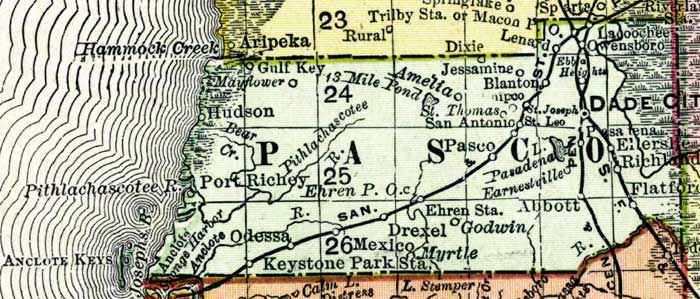
Eager to visit the area, my husband and I ventured down Old Pasco Road from Wesley Chapel to highway 52 via Old Pasco Road and then turned east to travel down Pasco Road into San Antonio, we both recognized that there could be confusion between Old Pasco Road and Pasco Road and wanted to distinguish the area for ourselves. It appeared to me that “Pasco Station” was a stop/make-shift depot of the Orange Blossom Railway area. I suggested that Kathy check out the work of Dr. Susan MacManus (books: Citrus, Sawmills, Critters & Crackers (1998) and Going, Going, Almost Gone and Lutz-Land O’ Lakes Pioneers Share Their Precious Memories (2011) to get a feel for the bordering areas to the west of Pasco Station as well. Susan’s focuses on her home area of Land O’Lakes and Lutz but might offer some insights. My books on Wesley Chapel and Dade City focus more on the east side of Pasco County.
We walked through the swampy land to the west at the intersection of Old Pasco Road and 52 and then drove a few miles up and down Old Pasco Road.
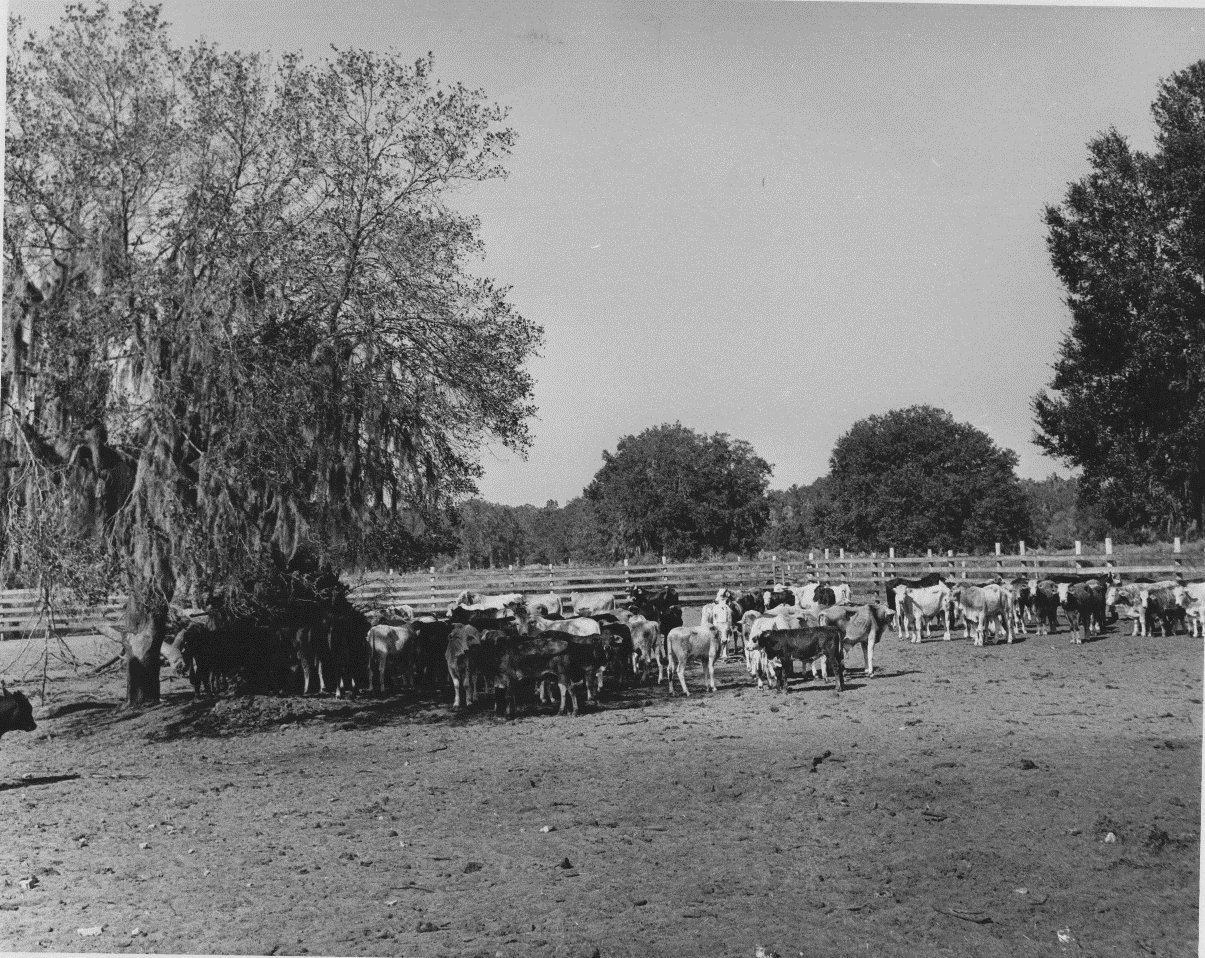
The new subdivision on the east side of 52 as it meshes with Tampa Bay Golf and Country Club, hides any historical reference to Pasco Station other than the signage. The west side of Old Pasco Road, however, has a sand road area that may have been railroad bed that glimpses many acres of pastureland with modern-day beef cattle. Truly I sighed because- staring out at the pastureland, one could have an essence of the feeling of what it must have looked like for the ranchers and settlers.
My next plan was to bring in another descendant of the area, David Brown who worked with me on the Images of America: Wesley Chapel book and is the grandson of a ranching family in Wesley Chapel, the Reuben Barnes family.
(Truly we may have overwhelmed Kathy with our back-and-forth conversations via technology about the area as we spent many hours consulting on the previous work. Now, wouldn’t the ancestors be in disbelief at our email communication?
Here are some responses from David:
- Pasco Station was literally the intersection of S. R. 52 and Old Pasco Road (not to be confused with Pasco Road which is east of I-75). There were literally a few houses, the Depot (north of 52) and an old church/school building on the southeast corner which Bernie McKendree later used for a hay barn before it was torn down. I have a picture of it somewhere, said David. (Note that this configuration is substantiated by Ted Williams, and you will see documentation as you continue to read through.)
- My (David’s) Grandmother Isabel Helveston Barnes was born and raised in Pasco Station. Her mother was Alatha Tucker Helveston. Most of the residents were Tuckers and are buried in Emmaus Cemetery just east of One Pasco Center on the north side of 52. I also have a picture of grandma and her mother in the front door of their old “shotgun” house. (Note that shotgun houses were narrow rectangular houses with a breezeway; the name came from the myth that one could fire a shotgun through the house without injuring anyone but in reality, the style aided in capturing breezes and cooling)
- Mr. McKendree owned all the land from north of Overpass Road to north of Pasco Station and from McKendree Road (east of I-75) west almost to Ehren.
- “Mr. Bernie” as he was known and his wife were nice people. Both he and my grandfather, Reuben Barnes, were particular about who they associated with and had impeccable reputations. Theirs was not only a familial relationship but a symbiotic one as well. When my grandfather was working cattle. Mr. Bernie would send all his boys, horses, and dogs to help. And likewise, when Mr. Bernie was working cows, we would be there.
- I remember when interstate went through and almost split Mr. McKendree’s place in two.
Timeline
1864: Jane McKendree from Jasper, Georgia arrived with her two children to Pasco Station. Her husband, George Curley McKendree, a Confederate soldier, joined his wife later.
1879: Works Progress Administration Church Records: the Pasco Station church organized. “Services held under trees and arbors few months in 1879 during erection of building. Thefirst settled clergyman was Reverend R. E. Bell who served 1879-1883. In 1940, the location/address was Highway #210, 2 miles Northeast of Pasco (aka Pasco Station) between San Antonio and Pasco.
1887: Orange Belt Railway construction began in late 1887 and
1888: Regular rail service commenced on February 13, 1888; the future looked promising. At last supplies could come directly to San Antonio and agricultural products could be shipped to northern markets. First passenger train through San Antonio in 1888 as well
1892-1893: Minutes from June 6, 1892, show that a school at Pasco Station was approved.
A list of supervisors of schools as of August 7, 1893, shows Pasco: D. H. McCantry; and Pasco Station, Barney Estry Wells.
A list of recommended teachers on Sept. 4, 1893, shows Pasco Station, no. 13, with teacher, Mary Howell.
1894-1895 Back-to-back freezes in December of 1894 and February 1895 were set-backs. The first damaged leaves and fruit; the second, the “killer-freeze,” caught the trees in a flush of growth with the sap flowing upwards. This freeze decimated the groves as trees were split wide open when the sap froze.
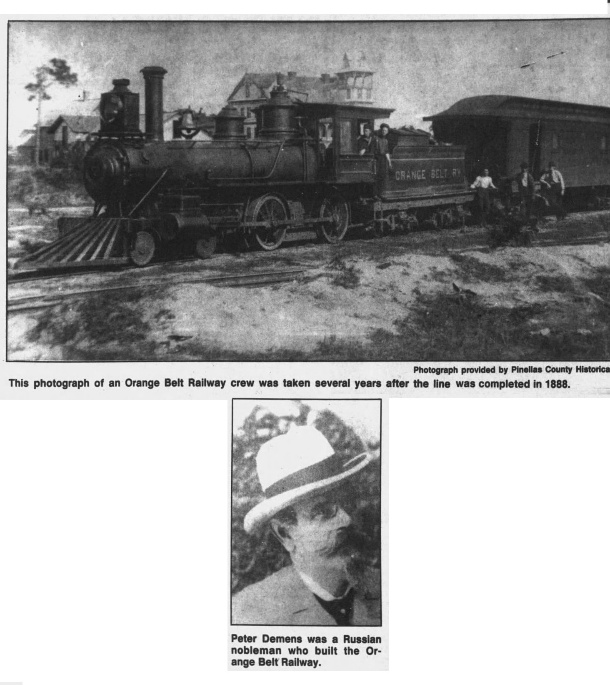
1896: The Orange Belt Railway became the Florida Central & Peninsular.
1902: The Atlantic Coast Line took over the Plant System and operated the trains until a 1967 merger with the Seaboard Air Line Railroad created the Seaboard Coast Line.
1906: The last Orange Belt Railway rolling stock passed by. The first Plant System broad gauge system train consisting of Engine No. 46, two freight cars, one mail, one express and two passenger coaches passed by and ended the faithful narrow-gauge system. The Orange Belt became the Plant System, operating under the names “Sanford and St. Petersburg Railroad” and later as the “Florida Central and Peninsular Railroad.” (Source: From The 1890-1906 Chronology of Benedict Roth, Pg 56, 1896)
1906: Pasco County Commission orderedbuilding of the ‘hard road’ as documented in Pasco County Commission minutes. It was a permanent public road established between Dade City and Fivay, by way of San Antonio and Pasco Station.
1906: Eight thousand acres were purchased by Ayman S. Goffin of Iseman & Goffin of Nassau Sound Packing Company near Pasco Station for sawmill (Florida Times Union)
1909: Pasco Commission approved same road: a ‘hard road’ from Dade City, and running West to the Coast,” and E. Pool was appointed as an Engineer and road expert to assist the appointed committee.
1910: Work on (the) hard road, was discontinued for lack of funds
1911: Pasco Station School and Emmaus School were consolidated by the Pasco School Board as they were less than three miles apart.
1914: Pasco Station was a stop on the ACL Railroad an east-west line that connected Lacoochee in the northeast part of the county to Anclote on the west coast of the county as reported in the Dade City Banner (indicating that there was a “stop” at Pasco Station).
1915: Lottie Guy Cripe taught a six-month term at Pasco Station School for $40 per month (She retired in 1959 after service in Pasco County schools.
1921: Per the Dade City Banner of February eleventh- “Pasco. A little station four miles west of San Antonio known as Pasco Station had its post office was discontinued a year ago, but a rural mail line runs through the burg.
1922: A Pasco County bond measure created the Dade City & West Coast Road, a hard surface macadamized road with eight inches of crushed rock, named Pasco Road on December 15, 1923. It became SR 210 about 1939 and SR 52 in the late 1940s. Prior to the early 1920s, Emmaus and Emmaus Baptist Church were served by dirt roads and the Orange Belt Railway.
1923: An advertisement for 120 acres of land near Pasco Station for $15 per acre with one mile of fencing is posted in the Tampa Tribune by Lamar Rankin.
1924: Tampa Morning Tribune reports that Messers Lanier and Strickland captured a wild cat and previously Bernie McKendree came upon five wild cats in the Pasco Station area.
1924: Dade City Banner – August 8th reported that – Pasco Station would host an all-day service at the following Sunday. In the morning there will be singing, followed by dinner, at noon, which will be spread on the grounds. Singing will also be the main item of the program until 4 p.m., when the regular preaching service will be held. “Everybody is invited to come and bring a basket.”
And announced the following week, “Everybody wishing to hear a good sermon come will not be disappointed with the preaching of Reverend R. Strickland followed by a song service at three o’clock.”
Not to be outdone, The Tampa Tribune penned on November 16th that members of the Ladies Missionary Societies of Pasco Station, Emmaus and area Pasco Baptist churches met at the home of Mrs. R.B. McKendree last Wednesday and spent the day quilting for the Orphanage at Arcadia. At noon a bountiful dinner consisting of chicken pilau, salads, entrees, cakes, pies, and other dainties were served to the great enjoyment of all present. Those participating in this pleasant affair were Mesdames T.R. Alexander, Douglas Abbott, C.H. Helveston, P.J. McKendree, W.R. McNatt, J.F. Bates, Mrs. D.D. Helveston and little Miss Mary Johnston.”
1926: The Dade City Banner wrote on July 23rd that a Fifth Sunday Sing and Dinner on the Grounds occurred at Pasco Station with a Missionary Rally of the Southern District of their association, composed of ladies from the five churches: Dade City, Zephyrhills, Aripeka, Emmaus and Pasco Station. Still celebrating the July 20th morning service by Reverend Rich of St. Petersburg with his cornet music.
1929: The largest illicit distillery ever found in Florida was reported two miles south of Pasco Station and included 1,200 gallon still and 18,000 gallons of mash (Florida Times Union)
1931: According to the Florida Department of Transportation (FDOT), the road was finally built by Pasco County in 1924-25. It became State Road 210 in 1931. It was apparently redesignated as SR 52 in 1945. The State Road Department was authorized to renumber state roads in 1941 but did not act until 1945 because of the wartime shortage of signage materials.
1933: Bill McKendree’s Store opened when Uncle Paul McKendree bought a ten by 20-foot building
1943: The Pasco Station School site was sold to M. Bernie McKendree and his wife for $25.00, as documented in the school board minutes from November 15, 1943.
1952: A tract of 4,100 acres near Pasco Station known as Brahman Hill Ranch (a Florida corporation composed of W.H. Lester Jr. of St Petersburg and Gene Pride and Leffie Hayman of Tampa) sold by Otto F Duetsch to Victor Hodnett and wife and family and $107,040 worth of cattle (including Santa Gertrudis bull valued at $1500
1963: Eminent Domain proceedings for the building of interstate 75 took 150 acres of land owned by Bernie McKendree, Inc.
1969: The railroad line running through Pasco Station was abandoned
1973: Pasco Station community Store as community service center at State Road 52 and Interstate 75 (organized by Vanilla Standifer and Brother Francis of Saint Leo)
1976: Voter registration bus was parked at McKendree’s Country Store in Pasco Station on June 25th for voter registration
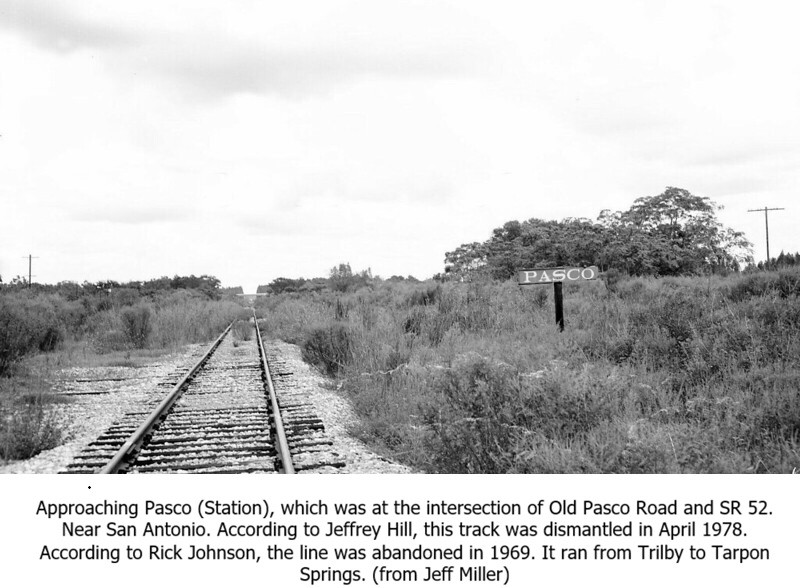
1978: Track of the railway line (originally Orange Blossom Railway) was dismantled
1985: Sandy’s Pasco Station at the corner of State Road 52 and County Road 581 was run by Jim Long and his sister Sandy as she purchased it in the 1940s
1992: Ray Bone operated Blanche’s Store which he obtained from the McKendree family
1996: Neon Cowboy opened as old-fashioned general store with Johnnie’s Bar-B-Q of Dade city providing food
1999: Wayne and Kathleen Lawrence began operating Neon Cowboy in Pasco Station area and Bellamy family bought back the property in May of 2003
2015: Neon Cowboy closed.
The General Store evolving and changing into Neon Cowboy as depicted in images from the media:


Information on the “other” known buildings of Pasco Station
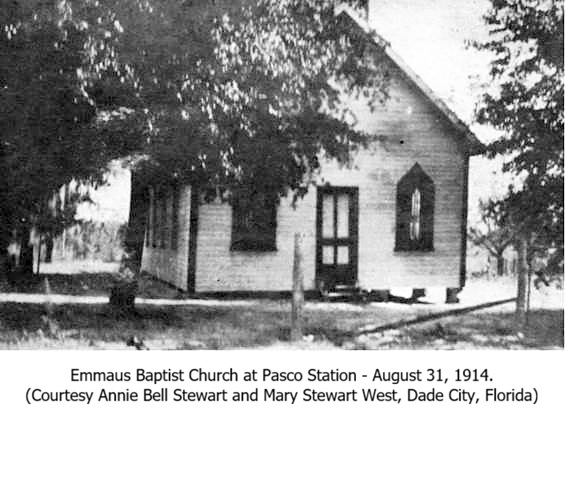
The Pasco Station Church is often confused with the Emmaus Church which was nearby and was erected in 1879 and closed in 1937. WPA records record that the original building was torn down in 1900 and the present building was erected as “wood, painted, and rectangular and rebuilt” as reported in the October 18, 1900- The San Antonio Herald reported that reconstruction was concluding on the handsome structure with credit to the congregation.”
Undoubtedly settlers attended both churches and many Pasco Station folks were buried at the Emmaus Cemetery over time. We know from school board records that the county superintendent and attendance officer inspected the schools in Pasco County.
Pioneer descendent David Brown explained that the Emmaus Cemetery was a good mile east of I-75 on the north side of 52 on Emmaus cemetery road. It was not part of Pasco Station. From a 2012 interview with Ted Williams by Judith Jolly, historian of the Baptist Church, we learn that this Baptist church was one of the oldest churches in Pasco County, between San Antonio and Pasco Station where one would turn on Road 210 when Williams was a child.
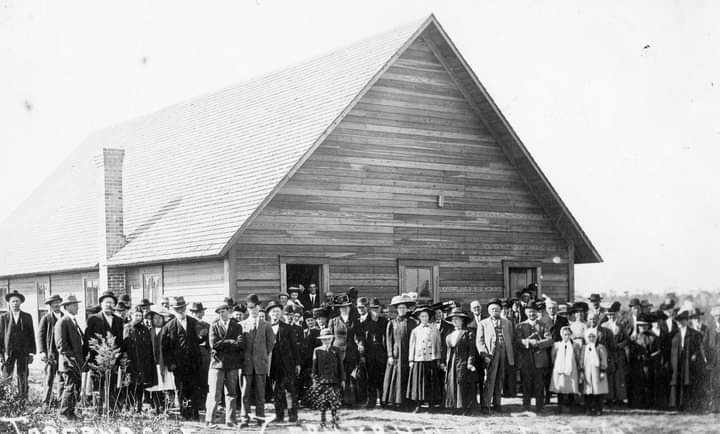
Photo courtesy of David Brown.
As a young boy Ted attended 5th Sunday sings and dinner on the grounds with his family. He said the church was located “right where those oak trees are,” in front of Emmaus Cemetery.
“There was another Baptist Church out there – Pasco Station Baptist Church on Pasco Road, south of 52. It was sold. Bernie McKendree bought it and stored his hay in it.” explained Ted Williams, former Pasco County Property Appraiser, in 2012.
Corroborating the existence of the Pasco Station Church was John McKendree, grandson of Bernie McKendree in 2013. He explained the building of the Pasco Station was located on Old Pasco Road, just past Smith Road. It faced east toward Pasco Road and was an unpainted wooden church of heart of pine. The church sat up off the ground about three feet with piers of lighter wood. It had many windows and high ceilings. It did not have a traditional steeple but did have a short steeple-like structure on the roof. It also had about three steps up into the entrance. The Sunday School rooms were on the immediate right and left just inside the entrance to the building with the church and pulpit area beyond.
Note that it is assumed that the school of Pasco Station operated from the church building as was often the custom of the timeframe and was also the case of Emmaus Church.
After the church of Pasco Station met its demise, the building was purchased by Bernie McKendree. John McKendree worked with his Grandfather Bernie and dragged bales of hay across the floor and stored them. He said the floor, also of heart of pine, was shiny/slick as could be from the ‘polishing’ it and eventually, the floor also dipped so me from the weight of the bales. John confirmed that the property was later sold and the church torn down.
Theda Bryant Tucker, the widow of Reverend Kenneth Lamar Tucker said in 2011 that an old wooden church stood for years in Pasco Station. Works Progress
Administration records harvested from 1914 indicated services since organization were held at the unpainted, rectangular, frame church with the first settled pastor of Reverend John William Wright as noted by Mrs. Fred H McKendree whose family was said to organize the church as documented in 1924 and 1949 deeds.
The Dade City Banner reported in 1921 the post office was discontinued from Pasco Station in 1921, but a rural mail line ran through the area. Mrs. McKendree further wrote, “there are one hundred people with a general store, schoolhouse, and two churches (presumably Emmaus and Pasco Station) There are fine fruit groves and these extend to the west.”
So what of the houses?
Accounts of the country along the Atlantic Coast Line railway west through the heart of this Pasco was described as a clean looking region. The farmhouses are unusually good, most of them painted white. The people are smart, wide-awake, and friendly.
By 1941 Ted Williams explained that folks had begun to move away from the Emmaus/Pasco Station/Emmaus communities during 1941 World War II into Tampa to work at the shipyards and in other steadier work, so eventually financial stability waned. Closure of the railroad impacted the area as the railroad tied communities like Trilby, San Antonio, St. Leo, Pasco Station, Ehren, Drexel, Odessa and Clearwater together somewhere beginning around 1900.
Various photos of Pasco Station


