Martha Oelsner
This article was published 11 February 2026 by Paul Herman, digital media archivist, West Pasco Historical Society
One of West Pasco County’s most influential, colorful, and liked pioneers was Martha Oelsner – a Port Richey resident for over five decades beginning in 1925. Born in New York City in 1886, Martha married Dr. Oscar Johnson in 1909 and together they had a son named Rensleo. Tragically, the boy drowned in a creek near their family home when he was just six years old.
Martha and her husband had been estranged at the time of their son’s death in 1915. And two years later they were divorced. Martha then assumed her maiden name of Oelsner and lived with her parents, Rudolph and Dora. She never remarried. In 1922, the family moved to Tampa, Florida. And then in March of 1925 they purchased property in Port Richey on the banks of the Cotee River.
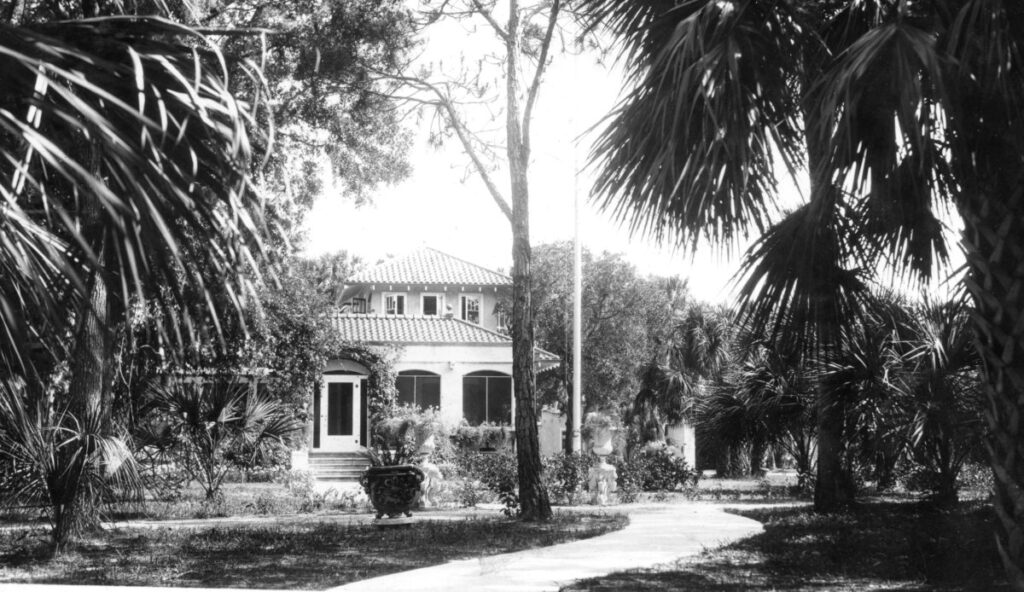
Their new homestead was purchased in two parcels from John and Margaret Hill, and W.E. and Mary Sorter, and included about 10 acres of land. Rudolph Oelsner immediately began building a house on the property. But before it was completed, tragedy again struck the family when he died on November 1, 1925. Despite that sad turn of events, Martha and her mother oversaw the completion of Rudolph’s elegant mansion.
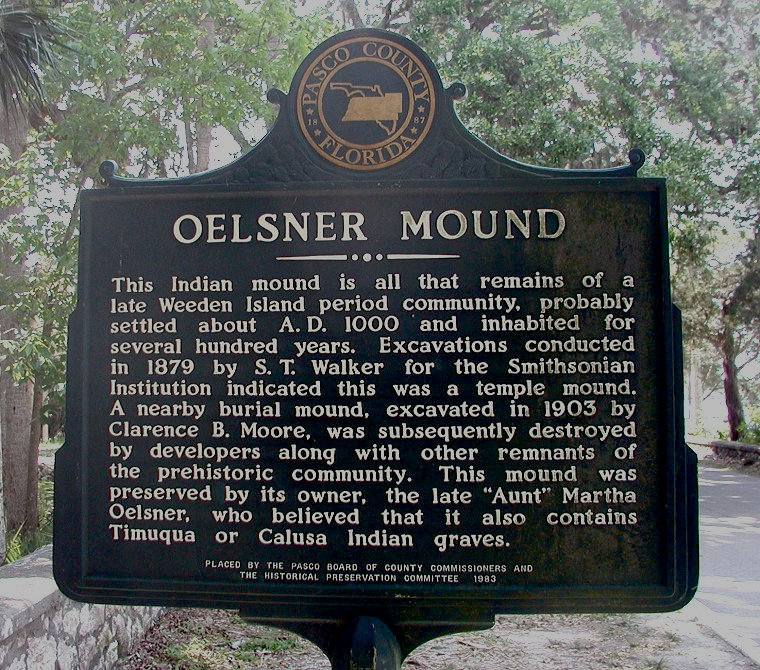
One of the unique features of the property purchased by Rudolph Oelsner was an Indian mound that many archaeologists say dates back to about 1,000 AD. It is thought to have been a temple mound used by Weedon Island and Safety Harbor Native American cultures. First investigated by S.T. Walker for the Smithsonian Institution in 1879, the mound (known then as the “Eschaskotes Mound”) was not found to contain any artifacts or human remains – instead being composed of layers of sand and shell. Exactly what you would expect if it were used as a platform mound. Walker’s expedition also discovered a large burial mound about 300 foot east of the Eschaskotes mound where bones, pottery, shell tools and pendents were found.
After the Walker expedition, wealthy explorer and amateur archaeologist Clarence Moore revisited the site in 1903. His attention was mostly on the burial mound where he unearthed the remains of at least 150 individuals, along with a significant number of other artifacts – many of which are now displayed at the National Museum of the American Indian in Washington, DC. Unfortunately, that mound was destroyed by later development in the 1950s.
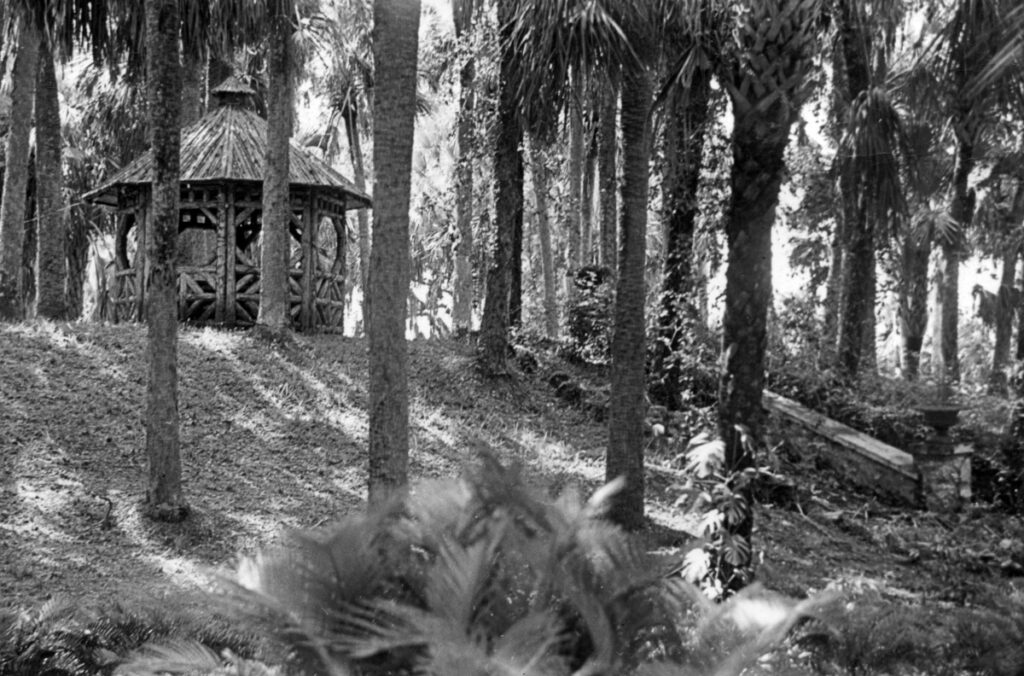
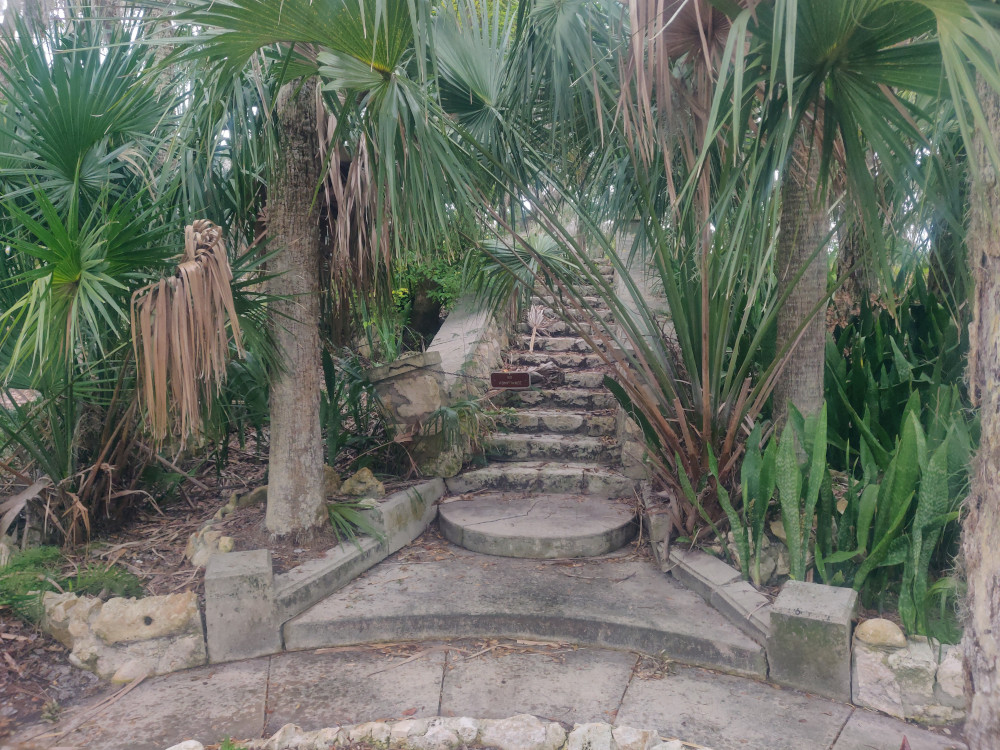
We don’t know if Rudolph Oelsner knew about the Indian mound when he first purchased the property. But Martha was very interested in the mound, and spent her entire life in Pasco County making sure it was preserved and protected. She added a set of concrete stairs on the east side of the mound, and built a gazebo on the top, so that she could sit and admire the same view of the Cotee River that the Native American ancestors must have enjoyed. She also collected many artifacts from the site which she kept in her home.
Unfortunately, the house was destroyed by fire in 1961, along with priceless antiquities acquired by her father, who was a collector of art treasures from all over the world. Most people who had the pleasure of visiting the Oelsner estate saw it as more of a museum than a private residence. Many of the artifacts Martha had collected from the Indian mounds were also lost in the aftermath of the fire.
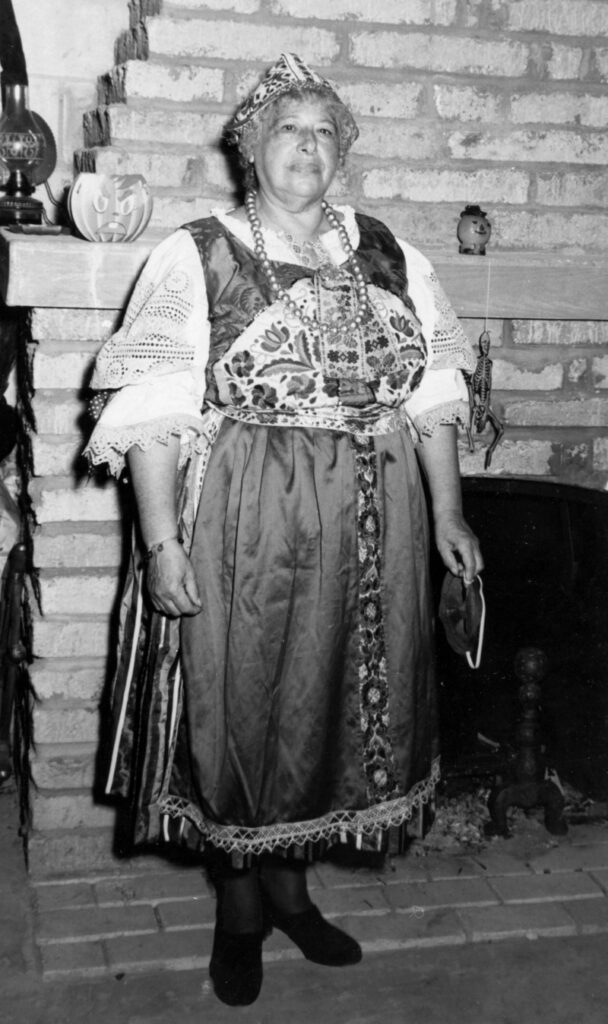
After her house was destroyed, Martha – even though she was now 75 years old – refused to leave the mound site. She built another home on the property and lived there until her death in 1981. Her final wish was that the property would be protected from development, and that the mound would be preserved in honor of her late son Rensleo. But when she died, it was discovered that the provision to preserve the mound had been removed from her will. The estate trustees transferred ownership of the Oelsner Mound to the Florida Sheriff’s Youth Ranches. A public campaign including writing a letter to the governor and negotiations with the Pasco County Historical Preservation Committee finally resulted in the property being deeded to Pasco County in 1989 with the stipulation that the historical and archaeological significance of the Indian mound must be preserved.
Having driven by the historical marker on Sunset Drive in Port Richey, many West Pasco residents may be familiar with Martha Oelsner’s connection with the Indian mound. But “Aunt Martha” – as she was generally known in the community – was much more than just a protector of the Oelsner Mound.
She served as chairman of the Chasco Fiesta boat parade for many years, and was active in many community organizations including the Chamber of Commerce, Woman’s Club, League of Women Voters, Cotee River Improvement Club, Audubon Society, the Garden Club, West Pasco Art Guild, and founder of the Richey Symphony Society. Her home, which she opened for many club events and galas, was surrounded by an expansive garden with native and exotic plants. She was known to decorate the entire property elaborately for Christmas.
On her birthday on October 4, 1971, Port Richey mayor John Durney proclaimed the day to be “Martha Oelsner Day”. And in October of 1974, the City of Port Richey dedicated its new city hall in her honor, with governor Lawton Chiles as guest speaker.
In addition to the property where her home and the Indian mound were located, Martha also owned a large tract of land north of Miller’s Bayou. In the 1950s she sold a portion of that property to be developed as a subdivision named “Martha’s Vinyard”. As a part of that land transaction, she dedicated a parcel on the Bayou to be used as a public park. It became known as Oelsner Park.
During her 57 years as a West Pasco resident, “Aunt Martha” always had a charasmatic personality, and used her influence to promote history and community events. She helped bolster the Native American culture through both the Chasco Fiesta and her preservation efforts for the Indian mound on her property. A storyteller at heart, she often spun a tale of the Timucuan Chief who was buried at the mound sitting astride his horse. While none of this was ever found to be true, her intention may have been to attribute reverence and respect to the property.
“Aunt Martha” was 95 years old when she died on December 10, 1981. She will always be remembered as one of West Pasco County’s most interesting and colorful pioneers. Now protected as an historic site by Pasco County, the Oelsner Mound will always be preserved as her legacy.