
West Pasco Chronicle
Article added by Paul Herman, WPHS Digital Archivist, on 23 Feb 2026.
The West Pasco Chronicle was started by Steve Meldon as editor and publihser, with its first issue printed on March 18, 1965. It was a weekly newspaper circulated every Thursday, and although it concentrated on news and happenings in the Hudson area, it was printed in New Port Richey by Florida Litho Company. It used the tagline “West Pasco’s Biggest Little Paper”. For the first two years the newspaper was a 5-column tabloid size publication averaging 4 to 8 pages in length.
Born on December 6, 1946, Steve Meldon was just 28 years old when he came to Hudson to visit his mother and other family members, and decided to stay in the West Pasco area. He was married to Joyce Faye Tate on December 22, 1964 – just two days before he moved to Florida. He was apparently a devout Christian man; his newspapers always included a column titled “Christ’s Corner”, and many of the news articles had information about local churches.
After only 4 issues, Steve Meldon turned the West Pasco Chronicle over to Edward P. Freeland, who was the president of Florida Litho Company. The reason for this change in publisher is unclear. Beginning with the April 22, 1965, issue, the principals for the West Pasco Chronicle were listed as; E.P. Freeland, editor & publisher; Ruth J. Freeland, associate editor; and May Plennert, social & sports editor. The news and editorial coverage of the paper shifted at that point to wider West Pasco County.
While the New Port Richey Library has extensive archives of the West Pasco Chronicle from the first issue, the period between March 4th and September 16th of 1967 is missing. It is interesting to note that issued in September and October of that year, the first page was printed sideways (landscape mode). The reason for this strange print format is not known- perhaps just to garner attention at the newsstands. Or, perhaps, it was to test the new full size newspaper format that was launched on November 2, 1967.
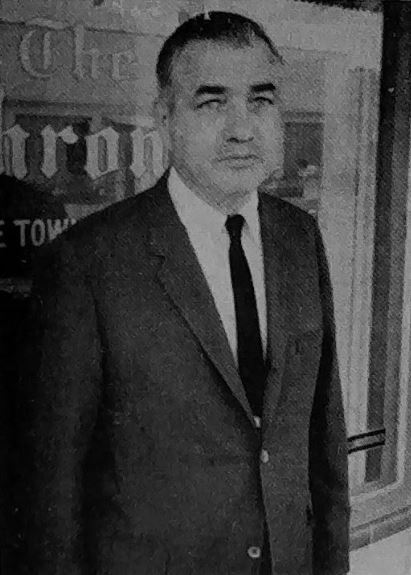
The November 2, 1967, issue of the West Pasco Chronicle was the launch of several major changes. Florida Litho Company, owned by Ed Freeland and his wife, Ruth, had sold the newspaper to a New Port Richey corporation with the name “Chronicle Publishers Inc.”. Their offices were at 119 W. Main Street. Headed by James M. Talley, president & publisher – who was also the publisher of the Sun-Journal newspaper of Brooksville. Printing operations were to be moved to Brooksville, and utilize the same modern presses used by his other newspaper.
In addition to a new owner, the West Pasco Chronicle now had Don E. Beattie as its editor & manager. Mr. Beattie was a seasoned newspaper editor with 26 years of experience with Ohio area papers including the Salem Ohio News, the Ashland Times-Gazette, the Cincinatti Enquirer and the Cleveland Press.
Not only was it now a full size newspaper, but the publication date was moved to Thursdays of each week, with distribution spanning West Pasco County from Aripeka to the Pinellas County line. At that point in late 1967 the “Chronicle” had an average circulation of between 10,000 and 15,000 copies per week – eclipsing its competitor the New Port Richey Press. Its main claim to fame going forward was that it used state-of-the-art photographic techniques for publishing, instead of the more traditional letterpress process – allowing it to feature sharper text and pictures.
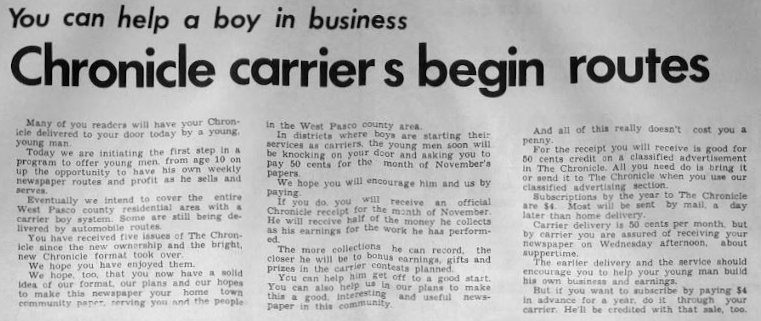
The new Thursday publication date was short-lived. On November 29th of 1967, the newspaper reverted back to its normal Wednesday weekly release. This change coincided with the naming of Wayne Walter as its circulation manager. One of the changes he implemented was in how the paper would be delivered to its local customers. Up to this point, subscribers received their issues from drivers personally delivering copies by automobile. But going forward, the newspaper would employ up to 40 newspaper boys to hand deliver the West Pasco Chronicle on foot or by bicycle. The cost for an annual subscription to the Chronicle was $4.00 in 1967. But you could get the newspaper with home delivery for 50 cents per month – and the newsboy made 25 cents for himself.
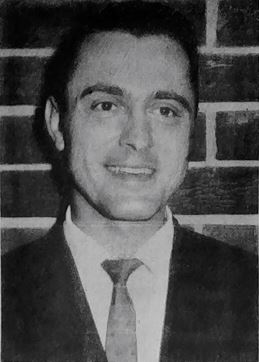
On April 2, 1969, it was announced that Don Beattie had resigned as editor and manager of the newspaper. He was succeeded by Robert W. Brooks, a former editor of the Springfield Herald (Tennessee). Mr. Brooks, a native of Nashville, Tennessee, began his newspaper career in 1961. When he took the job as general manager of the West Pasco Chronicle, he moved to New Port Richey with his wife Betty and their three children.
On November 26, 1969, with no fanfare or mention of a change in the paper, Robert Brooks was listed as both the publisher and manager of the West Pasco Chronicle in the masthead. This change also came with a new publishing company – Pasco Publishers, Inc. The newspaper is now averaging 10 to 12 pages per issue, and beginning on January 15, 1970, L.G. Cobb becomes the editor.
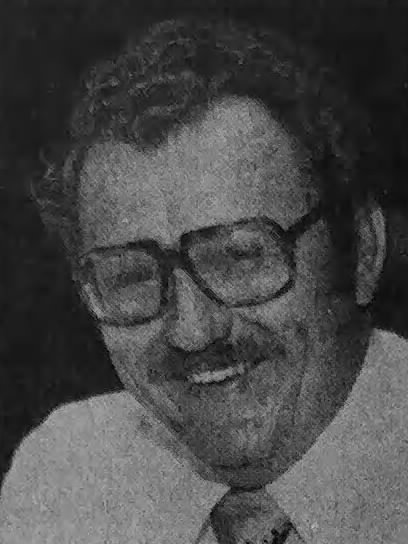
In the July 15, 1970, issue of the West Pasco Chronicle, the masthead no longer shows Robert Brooks as publisher and manager – only that L.G. Cobb is the editor. There is no mention of this in any newspaper article or editorial, but it seems that leadership changes may be afoot. On September 9 of 1970 it is revealed without fanfare that John Walter Starkey is now the general manager of the newspaper. John moved to the New Port Richey area in 1970, and at 26 years old was one of the youngest managers in the business. He worked for the Chronicle for about two years, and then joined his father, Floyd Starkey, as owner of the Starkey Insurance Agency in New Port Richey.
By late October, 1970, L.G. Cobb is no longer listed as the editor of the Chronicle, leaving John Starkey completely in charge of the paper. The circulation is now 16,000 copies per week, being delivered to west Pasco, north Pinellas and south Hernando counties. On October 13, 1971, John Starkey was replaced by Mary Mercelis as editor of the Paper. By the end of 1971, circulation had grown to 21,500 copies per week. By early 1972, the circulation was reported to be 21,500 copies per week.
On February 1, 1972, James H. Dryden bought the West Pasco Chronicle from Pasco Publishers and took over operation. He assumed the duties of editor and publisher of the newspaper. Dryden came to west Pasco County from Valley Forge, PA, where he was employed by the missile and space division of General Electric Company.
In April of 1973, James Dryden launched a new paper called the “Pasco Penny Pincher”.
The West Pasco Chronicle changed to a tabloid sized 11×16 inch format beginning with the October 18, 1973, issue. The November 1, 1973, issue of the Chronicle included the “Pasco Penny Pincher” as a supplement. Going forward, it appears that the advertising supplement was denoted by lettered pages – but not with the name “Pasco Penny Pincher”. In April of 1974, Fay Lair is added to the staff as assistant editor.
In August of 1975, the West Pasco Chronicle and the Pasco Penny Pincher, along with the Suncoast Shopper (owned by Tom Smith), were sold to the Orlando Sentinel Star Company. The consolidated newspaper would continue to be published in the West Pasco area under the name “Suncoast Shopper & News”. The new headquarters were at the Suncoast Shopper building, 607 W. Main Street, New Port Richey. The newspaper would now be printed in Manatee County, where the Suncoast Shopper had been printed. The building that had housed the West Pasco Chronicle at 621 Gulf Drive was to be converted into a professional office building.
At the time of its purchase, the circulation of the West Pasco Chronicle had shrunk to about 4,000 copies per week, and a subscription was $4.00 per year. After the merger, It became a free newspaper. James H. Dryden remained as business manager of the Suncoast Shopper & News until July, 1977.